Friday, February 28, 2020

Facebook brings its 3D photos feature to users with single-camera phones

Facebook first showed off its 3D photos back in 2018, and shared the technical details behind it a month later. But unless you had one of a handful of phones with dual cameras back then (when they weren’t so common), you couldn’t make your own. Today an update brings 3D photos to those of us still rocking a single camera.

In case you don’t remember or haven’t seen one lately, the 3D photos work by analyzing a 2D picture and slicing it into a ton of layers that move separately when you tilt the phone or scroll. I’m not a big fan of 3D anything, and I don’t even use Facebook, but the simple fact is this feature is pretty cool.

The problem is it used the dual camera feature to help the system determine distance, which informed how the picture should be sliced. That meant I, with my beautiful iPhone SE, was out of the running — along with about a billion other people who hadn’t bought into the dual-camera thing yet.

But over the last few years the computer vision team over at Facebook has been working on making it possible to do this without dual-camera input. At last they succeeded, and this blog post explains, in terms technical enough that I’m not even going to attempt to summarize them here, just how they did it.

The advances mean that many — though not all — relatively modern single-camera phones should be able to use the feature. Google’s Pixel series is now supported, and single-camera iPhones from the 7 forward. The huge diversity of Android devices makes it hard to say which will and won’t be supported — it depends on a few things not usually listed on the spec sheet — but you’ll be able to tell once your Facebook app updates and you take a picture.


from Social – TechCrunch https://ift.tt/2uDFgHI

How To Download Windows 10 20H1 RTM (19041) ISO Files

Windows 10 latest 20H1 RTM (19041) ISO Files

Microsoft released the RTM build for Windows 10 20H1, or version 2004, way back in December 2019. However, between the time frame of its release date to when it ships to the public, Microsoft pushed a few cumulative updates.

The idea behind that is to make sure that there’s isn’t any critical issue with the build. The reason why we are talking about the RTM build is that Microsoft recently released the ISO files of Windows 10 build 19041 on the insider download page.

How To Download Windows 10 20H1 RTM (19041) ISO Files

So, if you are waiting for ISO images of the RTM build to install on your device, then you can now grab the ISOs of the latest Windows 10 build 19041. The newest ISO files allow users to perform a clean install of the Insider build 19041.

How To Download Windows 10 19041 ISO file?

If you are interested in checking out what’s new in Windows 10 build 19041, then you can grab the ISO files to install it on your device. To download the Windows 10 1904 ISO files, you need to follow some of the simple steps given below.

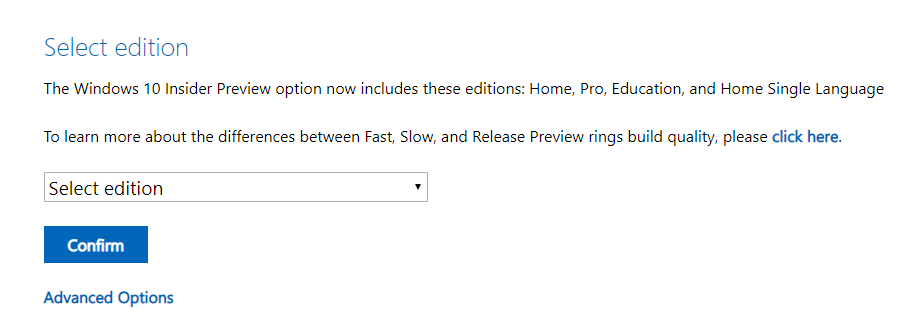
  • First of all, visit the Windows Insider Program website and login with your Microsoft account.
  • Scroll down and select ‘Windows 10 Insider Preview (SLOW) – Build 19041.’

  • Next, select the desired language.

  • Now under the download section, pick 32-bit or 64-bit ISO file.

That’s it! You are done. Now you will be able to download the ISO files. Once downloaded, you can perform a clean installation of Windows 10 20H1.

So, this article is all about how to download Windows 10 1904 ISO files. If you have any doubts related to this, let us know in the comment box below. I hope this article helped you! Share it with your friends also.

The post How To Download Windows 10 20H1 RTM (19041) ISO Files appeared first on Tech Viral.


from Tech Viral https://ift.tt/2wgql6E

AI ethics plan agreed by Catholic Church and tech giants

The Church signed up to the future of AI - an ethical one - along with Microsoft and IBM.

from BBC News - Technology https://ift.tt/32xNWfp

Teen hit Yolo raises $8M to let you Snapchat anonymously

It wasn’t a fad. Yolo became the country’s No. 1 app just a week after launch by letting teens ask for anonymous replies to questions they posted on Snapchat. But nine months later, Yolo is still in the top 100 iOS apps and has 10 million active users. Now it’s safeguarding the app from predators while revealing a smart new feature for spinning up anonymous group chats, powered by $8 million in fresh funding.

“What we are trying to build is a new kind of network where there’s a fluidity to identity,” Yolo co-founder Greg Henrion tells me. “We weren’t sure if Yolo was here to stay, but we’re still ranking well and there seems to be a real opportunity in anonymity starting with Snapchat Q&A.”
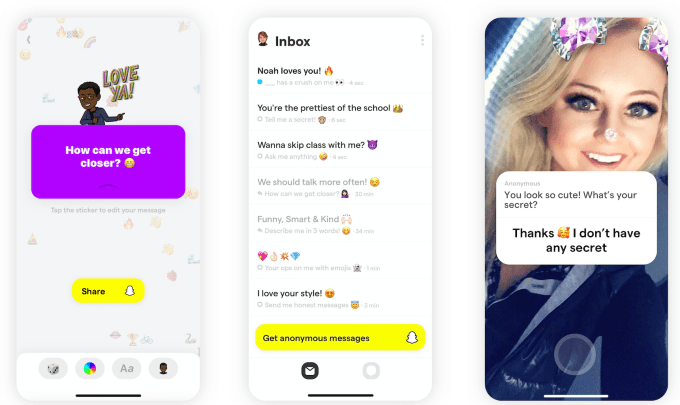
Yolo is the first big win for Snapchat’s Snap Kit platform that lets developers piggyback on its login, Bitmoji avatars, stickers and Stories. This lets tiny development teams build apps that hundreds of millions of people, teens in particular, can instantly sign up for in just a few taps. Another Snap Kit app for meeting new people called Hoop recently spiked to No. 2 on the charts

We haven’t seen this kind of social platform success since Zynga’s empire rose atop Facebook. Spawning more blockbusters like Yolo could ensure that a Snapchat account is a must-have utility for the next generation.

Sleepless nights atop the charts

“For two weeks we basically didn’t sleep,” Henrion recalls about the chaos he and co-founder ClĂ©ment Raffenoux endured after Yolo shot to No. 1 last May. “You’re trying to stay afloat. It was very, very wild.”

The basic premise of Yolo is that you write a question like, “Who’s my celebrity look alike?”, “What do people really think of me?” or “How could I be nicer?”. You’re then switched over to Snapchat, where you can post the question in your Story or messages with a link back to Yolo. There, people can anonymously leave a response; you can post that and your reply with another post on Snapchat.

Yolo co-founder and CEO Greg Henrion, in real life and Bitmoji

The result is that friends and followers feel comfortable giving you real talk. They don’t have to sugarcoat their answers. And that makes people race to open Yolo each time they get a message. Yolo has seen 26 million downloads across iOS and Android globally, with nearly 70% in the U.S.

Other anonymous apps like tbh (acquired by Facebook) and Sarahah (kicked off the app stores) quickly faded, and others eventually imploded due to bullying, like Secret and YikYak. Although tbh hit No. 1 in September 2017, it was out of the top 500 by November. It seems a combination of inherent virality via Snapchat, easy user acquisition via Snap Kit and sharp product design has given Yolo some staying power. It still managed 2.2 million downloads last month versus a peak of 5.5 million in its first month back in May 2019.

That June, Yolo quietly raised a $2 million seed round thanks to its sudden success. The team had been grinding since 2017 on a video reactions app called Popshow funded by a small pre-seed round from SV Angel, Shrug Capital and Product Hunt’s Ryan Hoover. They’d previously built music video-making app Mindie that eventually sold to influencer collective Shots Studios. Popshow never caught on, so the team began experimenting on Snap Kit, building a more official Q&A feature for Snapchat than predecessors like Sarahah and Polly. Then, boom. Days after launch, Yolo’s usage exploded.

But to keep users interested, Yolo needed to evolve. That would require more funding for the eight-person team split between Snapchat’s home of Los Angeles and Henrion’s home of Paris.

An honest way to chat

The concept of a social app where users could shift between full anonymity and representation via avatar attracted its $8 million Series A to invest in product and engineering. The round was led by Thrive Capital, Ron Conway’s A.Capital, former TechCrunch editor Alexia Tsotsis’ Dream Machine, Shrug, Day One, Goodwater, Knight VC, ex-Facebooker Bobby Goodlatte, Twitter co-founder Biz Stone and SV Angel’s Brian Pokorny.
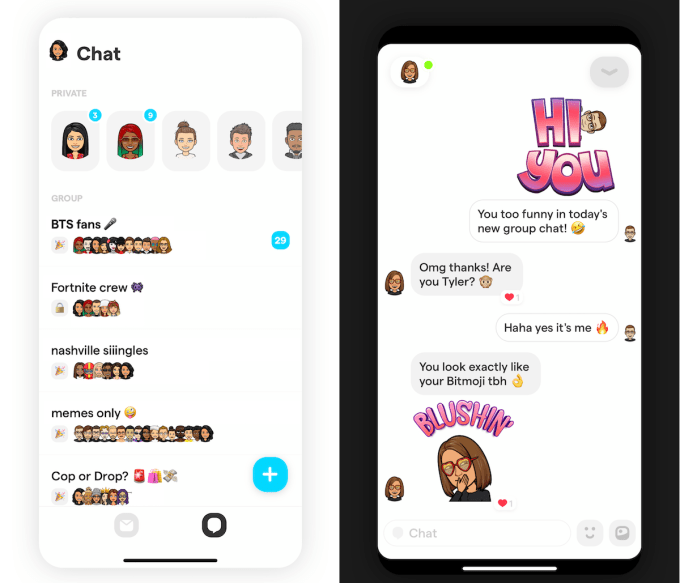
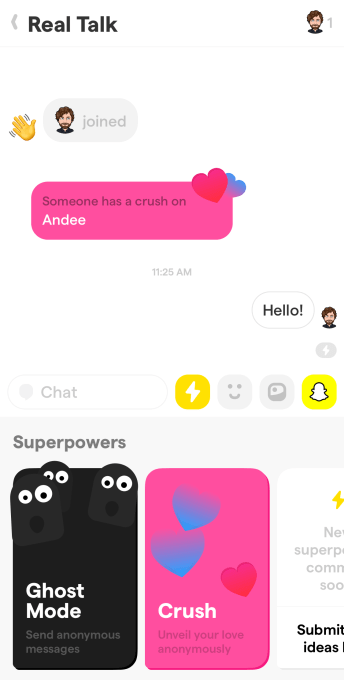
That cash fueled the release of Yolo’s new group chat feature. You can set up a chat room, give it a name and generate an invite URL or sticker you can post on Snapchat, just like its previous question feature. Friends or friends of friends that are already in can join the group chat, represented by their Bitmoji instead of their name. Yolo suggests people join the more open “party mode” chats where their friends are active.

What makes this special is that once an hour, users can tap the Yolo Superpowers button to send  a totally anonymous message to the group. More Superpowers are coming, but there’s also an anonymous “Someone has a crush on [name]” message so you can secretly profess your affection to anyone or someone else in the chat.

“The limits of Q&A is that it doesn’t generate real conversation. It’s an ice breaker, but we also want conversations to happen,” Henrion stresses. ” ‘What do you think about this dress?’ The group chat is more about ‘let’s talk about the dress.’ ” The chats could be focused on people you actually know offline, or those you share interests with. The option to restrict group chats to either just your contacts or friends of friends “limits the amount of meeting strangers,” Henrion explains. “This is very different from the public communities like Reddit or the dating apps.”

Can “anonymous” be synonymous with “safe”?

Still, anonymous apps have consistently proven to be havens for cyberbullying and unsafe behavior. Without the accountability of having your name attached, people are free to say awful things. That can be even worse amongst teenagers who might get in trouble for being mean at school but not on an app.

Yolo first focused on messages blocking 10% of overall messages that contained offensive content. That meant blatant hate speech and trolling couldn’t spread through the app. “We’re strict on moderation. When looking at the reviews about bullying, it’s like nothing compared to any other anonymous app. I think we solved 90% of the problem.”

Now it’s working with Snapchat to safeguard the group chats feature. The goal is to ensure Yolo doesn’t actively recommend chat amongst adults to minors and vice-versa. Henrion says this update should roll out soon.

“It’s 2020 and we need to be very responsible” Henrion tells me. “Moderation and growth are the most difficult things to balance. It’s moderation first for sure. We don’t care about growth if it’s not healthy or sustainable.” The new funding also gives Yolo the luxury of pushing back monetization while it focuses on safely adding more users.

By making anonymity more private, Yolo has a chance to sidestep some of the worst elements of human behavior. Making fun of someone has less appeal if there’s no wider audience like trolls exploited in the feeds and comment reels of Secret and YikYak.

That could let the brighter side of anonymity shine through: vulnerability, honesty and deep connections that are enhanced by the absence of embarrassment. With all the change, uncertainty and anxiety that’s part of growing up, teens deserve a place where they can be open with each other and speak their minds. After all, you only live once.


from Social – TechCrunch https://ift.tt/2I69LcA

If virtual worlds are so popular, why don’t we have them yet?

If virtual worlds are so enticing, why haven’t we already shifted to them as our online social hubs?

The thought of virtual worlds for socializing evokes Second Life (launched in 2003), where users created unique avatars to socialize, build and trade with each other. Contemporaneous press hype told us that our entry into the metaverse appeared imminent, and a 2006 cover story in BusinessWeek magazine featured an analyst who predicted that Second Life could displace Windows as the leading PC operating system.

That didn’t happen.

Granted, Second Life is still around, albeit with only a few hundred thousand active users. Eve Online is another long-running, open-world MMO where the experience is shaped by users’ contributions and social interactions. It’s been the subject of numerous studies on economics and psychology, given the depth of its data on human interaction, but it remains niche as well.

The popularity of Roblox, which surpassed 100 million MAUs and 40 million user-created experiences in August, and Minecraft, which surpassed 112 million MAUs, shows this movement gaining traction in a bigger way among the youngest generation of internet users.

There are both technical reasons and cultural reasons why participation in virtual worlds will finally go massively mainstream in the next few years.

On the technical side, most consumers have lacked the high-performance hardware necessary to meaningfully participate in advanced MMOs while going about their daily lives. And even if they had the right hardware, they weren’t entering one shared virtual space with all other users, they were just entering one instance of that world which was limited in scope and player count by the capabilities of a single server.

(This is part four of a seven-part series about virtual worlds.)

That’s all in the process of changing:


from Social – TechCrunch https://ift.tt/32B5Lu7

Coronavirus: Amazon removes overpriced goods and fake cures

The retail giant is removing fake cures and tackling unreasonable price hikes amid public concern.

from BBC News - Technology https://ift.tt/2VvmzkH

How to Convert 4K Video to MP4 – Best Video Converters in 2020

How to Convert 4K Video to MP4 - Best Video Converters in 2020

Well, if we talk about the media file formats, HD (High definition) had always provided us highest resolution and supreme audio quality. However, with the adaption of 4K in digital televisions, Digital Cinemas, and even on smartphones, HD is slowly losing its spark. Today, one can easily record a 4K video from DSLR, Android smartphone, iPhone, etc.

However, as compared to the recording, managing 4K files are not that easy. So, to manage or play the 4K files in mid-end smartphone or computer, one needs to convert the file format. In this article, we have shared some of the best converters to convert 4K HD to MP4.

How to Convert 4K Video to MP4 – Best Video Converters in 2020

It’s worth noting that there are plenty of video converters available for the Windows operating system, but not all of them support the 4K file format. So, in this article, we have listed the ones which support 4K HD video. So, let’s check out the best video converter to convert 4K video to MP4.

1. DVDFab Video Converter

DVDFab Video Converter

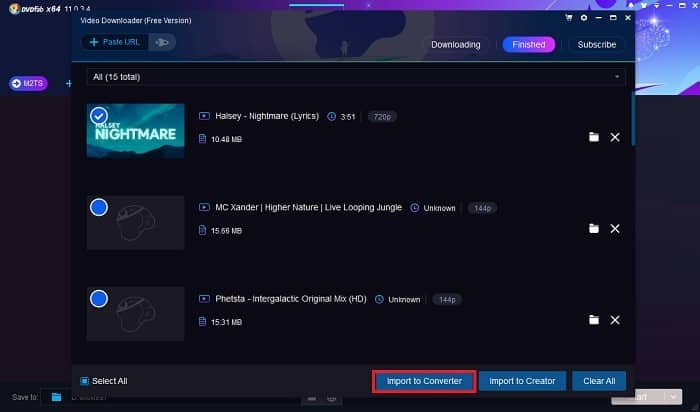
DVDFab Video Converter is one of the most popular video converters on the list that can be used on Windows 10 computers. The great thing about DVDFab Video Converter is that it supports a wide range of video and audio file formats. If we talk about the 4K videos, DVDFab Video Converter can easily convert 4K videos into MP4. Not just MP4, but DVDFab Video Converter can be used to convert 4K HD videos into other file formats as well.

2. Any Video Converter

Any Video Converter
Any Video Converter

Well, the older version of Any Video Converter doesn’t have the support for 4K videos; however, in the latest version, it supports the 4K HD Videos. That means Any Video Converter can be used to convert MP4 to 4K or 4K to MP4. The most noticeable thing of Any Video Converter is its user interface which looks clean and well organized. If we talk about the file support, Any Video Converter supports almost all major file formats. However, the converting speed of AVC is bit slow compared to other file converters.

3. Acrok HD Video Converter

Acrok HD Video Converter

Acrok HD Video Converter is one of the best and most powerful video converters on the list that can be used to convert 4K HD videos into MP4. The great thing about Acrok HD Video Converter is that it has a built-in media player that can be used to play the video. Apart from that, Acrok HD Video Converter can help you to convert videos into FLV, AVI, WMV, MKV, MP4, MPEG, etc.

4. Xilisoft Video Converter

Xilisoft Video Converter

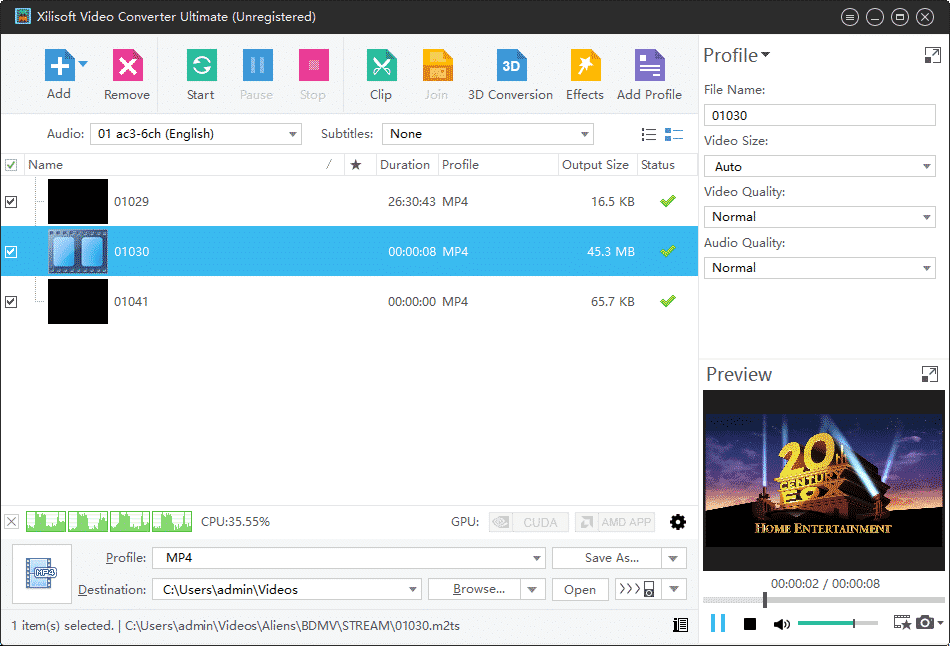
Well, if you are searching for a lightweight and easy to use video converter for your Windows 10 PC, then you need to give Xilisoft Video Converter a try. Guess what? Xilisoft Video Converter is known for converting various high-definition videos like 4K, UHD, etc. It’s also one of the fastest video converters out there. Apart from that, it got the ability to convert multiple files at the same time. So, Xilisoft Video Converter is another best and top-rated free 4K to MP4 converter that you can use right now.

5. Pavtube Video Converter Ultimate

Pavtube Video Converter Ultimate

Pavtube Video Converter Ultimate is one of the powerful video converters that you can use on your Windows 10 computer. The great thing about Pavtube Video Converter Ultimate is that it has a built-in media player and a video editor. The 4K video converter is known for its super-fast conversion speed for videos while converting 4K to other resolutions. Apart from that, Pavtube Video Converter Ultimate got support for more than 200 file formats.

So, these are the five best 4K to MP4 video converter that you can use today. If you know any other converter like these, let us know in the comment box below.

The post How to Convert 4K Video to MP4 – Best Video Converters in 2020 appeared first on Tech Viral.


from Tech Viral https://ift.tt/32xiPAC