Thursday, September 27, 2018

What Is ‘ADB’ On Android And What It Does?

Have you ever wondered what exactly ADB is? What’s its role on an Android operating system? In this article, we have explored some of the exciting details about ADB or Android Debug Bridge. So, check out the article to know everything about ADB (Android Debug Bridge) What Is ‘ADB’ On Android And What It Does? If we look around, we will find an Android smartphone on every hand. In fact, Android is right now the most used operating system which is used by millions of users across the world. If you have been using Android for a long time, then

The post What Is ‘ADB’ On Android And What It Does? appeared first on Tech Viral.


from Tech Viral https://ift.tt/2NLl675

What Windows Do I Have? 4 Best Ways To Know Your Windows Version!

Windows has been here for a long time, but many users still ask ‘what version of windows do I run?”. Well, this is not a baseless question, and everyone should know the exact version of their Windows OS as it helps in many circumstances. So, check out the 4 best methods to know your Windows version and OS Build What Windows Do I Have? 4 Best Ways To Know Your Windows Version! Well, when it comes to the desktop operating system, nothing can beat Microsoft’s Windows. Microsoft Windows is right now the most used desktop operating system is the world.

The post What Windows Do I Have? 4 Best Ways To Know Your Windows Version! appeared first on Tech Viral.


from Tech Viral https://ift.tt/2OgZ3Vj

Fortnite pets not money-making exercise, expert believes

The latest update are more likely to be an attempt to broaden the game's player base, expert believes.

from BBC News - Technology https://ift.tt/2zAqcKM

Showbox Alternatives 2018: 8 Best Free Apps Like Showbox

In this article, we are going to explore 8 best Showbox alternatives which you can use on your Android to stream movies and TV Shows. These apps are nothing less than Showbox Apk and it will not disappoint you for sure. So, let’s explore 8 best Showbox Alternatives for Android 2018. Showbox Alternatives 2018: 8 Best Free Apps Like Showbox Well, if we take a look at Android’s Google Play Store, you can find lots of movie and video streaming apps over there. Android’s Google Play Store is slowly becoming populated with premium movie apps like Netflix, Hotstar, etc. However,

The post Showbox Alternatives 2018: 8 Best Free Apps Like Showbox appeared first on Tech Viral.


from Tech Viral https://ift.tt/2Qgk5kj

Pew: A majority of U.S. teens are bullied online

A majority of U.S. teens have been subject to online abuse, according to a new study from Pew Research Center, out this morning. Specifically, that means they’ve experienced at least one of a half-dozen types of online cyberbullying, including name-calling, being subject to false rumors, receiving explicit images they didn’t ask for, having explicit images of themselves shared without their consent, physical threats, or being constantly asked about their location and activities in a stalker-ish fashion by someone who is not their parents.

Of these, name-calling and being subject to false rumors were the top two categories of abuse teens were subject to, with 42% and 32% of teens reporting it had happened to them.
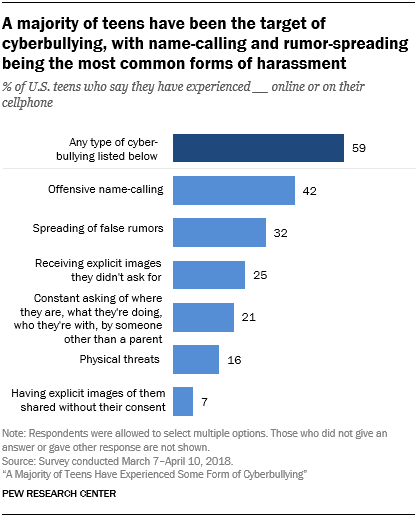


Pew says that texting and digital messaging has paved the way for these types of interactions, and parents and teens alike are both aware of the dangers and concerned.

Parents, in particular, are worried about teens sending and receiving explicit images, with 57% saying that’s a concern, and a quarter who worry about this “a lot.” And parents of girls worry more. (64% do.)
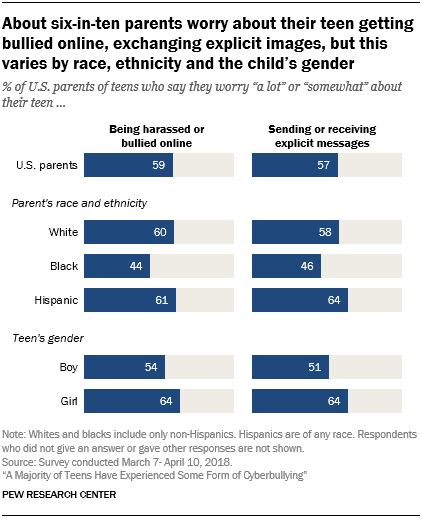
Meanwhile, a large majority – 90% – of teens now believe that online harassment is a problem and 63% say it’s what they consider a “major” problem.

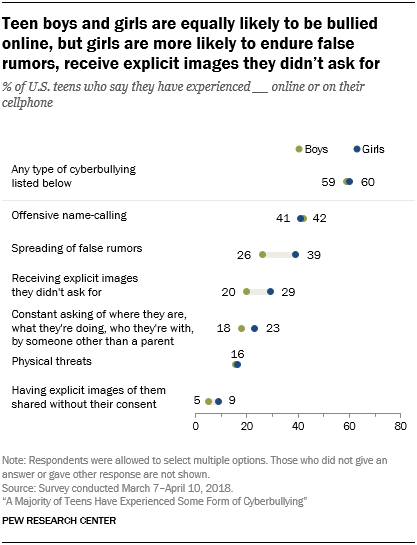
Pew also found that girls and boys are both harassed online in fairly equal measure, with 60% of girls and 59% of boys reporting having experienced some sort of online abuse. That’s a figure that may surprise some. However, it’s important to clarify that this finding is about whether or not the teen had ever had experienced online abuse – not how often or how much.

Not surprisingly, Pew found that girls are more likely than boys to have experienced two or more types of abuse, and 15% of girls have been the target of at least 4 types of abuse, compared with 6% of boys.

Girls are also more likely to be the recipient of explicit images they didn’t ask for, as 29% of teens girls reported this happened to them, versus 20% of boys.

And as the teen girls got older, they receive even more of these types of images, with 35% of girls ages 15 to 17 saying they received them, compared with only 1 out of 5 boys.
Several factors seem to play no role in how often the teens experience abuse, including race, ethnicity, or parents’ educational attainment, Pew noted. But having money does seem to matter somehow – as 24% of teens whose household income was less than $30K per year said they received online threats, compared with only 12% of those whose household incomes was greater than $75K per year. (Pew’s report doesn’t attempt to explain this finding.)

Beyond that factor, receiving or avoiding abuse is directly tied to how much screen time teens put in.

That is, the more teens go online, the more abuse they’ll receive.

45% of teens say they’re online almost constantly, and they are more likely to be harassed, as a result. 67% of them say they’ve been cyberbullied, compared with 53% who use the internet several times a day or less. And half the constantly online teens have been called offensive names, compared with just about a third (36%) who use the internet less often.

Major tech companies, including Apple, Google, and Facebook, have begun to address the issues around device addiction and screen time with software updates and parental controls.

Apple, in iOS 12, rolled out Screen Time controls that allows Apple device users to measure, monitor and restrict how often they’re on their phones, when, what type of content is blocked, and which apps they can use. In adults, the software can nudge them in the right direction, but parents also have the option of locking down their children’s phones using Screen Time controls. (Of course, savvy kids have already found the loopholes to avoid this, according to new reports.)

Google also introduced time management controls in the new version of Android, and offers parental controls around screen time through its Family Link software.

And both Google and Facebook have begun to introduce screen time reminders and settings for addictive apps like YouTube, Facebook and Instagram.

Teens seem to respect parents’ involvement in their digital lives, the report also found.
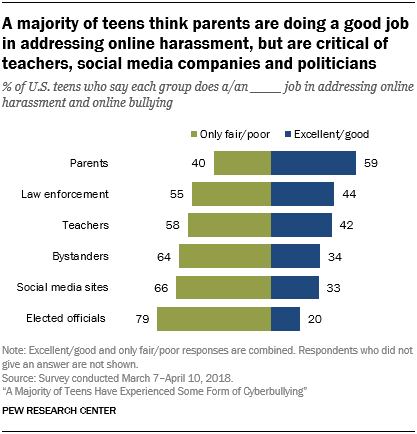
A majority – 59% – of U.S. teens say their parents are doing a good job with regard to addressing online harassment. However, 79% say elected officials are failing to protect them through legislation, 66% say social media sites are doing a poor job at stamping down abuse, and 58% of teachers are doing a poor job at handling abuse, as well.

Many of the top media sites were largely built by young people when they were first founded, and those people were often men. The sites were created in an almost naive fashion, with regard to online abuse. Protections – like muting, filters, blocking, and reporting, were generally introduced in a reactive fashion, not as proactive controls.

Instagram, for example – one of teens’ most-used apps – only introduced comment filters, blocklists, and comment blocking in 2016, and just four months ago added account muting. The app was launched in October 2010.

Pew’s findings indicate that parents would do well by their kids by using screen time management and control systems – not simply to stop their teenagers from being bullied and abused as often, but also to help the teens practice how to interact with the web in a less addictive fashion as they grow into adults.

After all, device addiction resulting in increased exposure to online abuse is not a plague that only affects teens.

Pew’s full study involves surveys of 743 teens and 1,058 parents living in the U.S. conducted March 7 to April 10, 2018. It counted “teens” as those ages 13 to 17, and “parents of teens” are those who are the parent or guardian of someone in that age range. The full report is here.


from Social – TechCrunch https://ift.tt/2Qc4It2

Facebook poisons the acquisition well

Who should you sell your startup to? Facebook and the founders of its former acquisitions are making a strong case against getting bought by Mark Zuckerberg and Co. After a half-decade of being seen as one of the most respectful and desired acquirers, a series of scandals has destroyed the image of Facebook’s M&A division. That could make it tougher to convince entrepreneurs to sell to Facebook, or force it to pay higher prices and put contractual guarantees of autonomy into the deals.

WhatsApp’s founders left amidst aggressive pushes to monetize. Instagram’s founders left as their independence was threatened. Oculus’ founders were demoted. And over the past few years, Facebook has also shut down acquisitions, including viral teen Q&A app TBH (though its founder says he recommended shutting it down), fitness tracker Moves, video advertising system LiveRail, voice control developer toolkit Wit.ai and still-popular mobile app developer platform Parse.

Facebook’s users might not know or care about much of this. But it could be a sticking point the next time Facebook tries to buy out a burgeoning competitor or complementary service.

Broken promises with WhatsApp

The real trouble started with WhatsApp co-founder Brian Acton’s departure from Facebook a year ago before he was fully vested from the $22 billion acquisition in 2014. He’d been adamant that Facebook not stick the targeted ads he hated inside WhatsApp, and Zuckerberg conceded not to. Acton even got a clause added to the deal that the co-founders’ remaining stock would vest instantly if Facebook implemented monetization schemes without their consent. Google was also interested in buying WhatsApp, but Facebook’s assurances of independence sealed the deal.

WhatsApp’s other co-founder, Jan Koum, left Facebook in April following tension about how Facebook would monetize his app and the impact of that on privacy. Acton’s departure saw him leave $850 million on the table. Captivity must have been pretty rough for freedom to be worth that much. Today in an interview with Forbes’s Parmy Olson, he detailed how Facebook got him to promise it wouldn’t integrate WhatsApp’s user data to get the deal approved by EU regulators. Facebook then broke that promise, paid the $122 million fine that amounted to a tiny speed bump for the money-printing corporation, and kept on hacking.

When Acton tried to enact the instant-vesting clause upon his departure, Facebook claimed it was still exploring, not “implementing,” monetization. Acton declined a legal fight and walked away, eventually tweeting “Delete Facebook.” Koum stayed to vest a little longer. But soon after they departed, WhatsApp started charging businesses for slow replies, and it will inject ads into the WhatsApp’s Stories product Status next year. With user growth slowing, users shifting to Stories, and News Feed out of ad space, Facebook’s revenue problem became WhatsApp’s monetization mandate.

The message was that Facebook would eventually break its agreements with acquired founders to prioritize its own needs.

Diminished autonomy for Instagram

Instagram’s co-founders Kevin Systrom and Mike Krieger announced they were resigning this week, which sources tell TechCrunch was because of mounting tensions with Zuckerberg over product direction. Zuckerberg himself negotiated the 2012 acquisition for $1 billion ($715 million when the deal closed with Facebook’s share price down, but later $4 billion as it massively climbed). That price was stipulated on Instagram remaining independent in both brand and product roadmap.

Zuckerberg upheld his end of the bargain for five years, and the Instagram co-founders stayed on past their original vesting dates — uncommon in Silicon Valley. Facebook pointed to Instagram’s autonomy when it was trying to secure the WhatsApp acquisition. And with the help of Facebook’s engineering, sales, recruiting, internationalization and anti-spam teams, Instagram grew into a 1 billion-user juggernaut.

But again, Facebook’s growth and financial woes led to a change of heart for Zuckerberg. Facebook’s popularity amongst teens was plummeting while Instagram remained cool. Facebook pushed to show its alerts and links back to the parent company inside of Instagram’s notifications and settings tabs. Meanwhile, it stripped out the Instagram attribution from cross-posted photos and deleted a shortcut to Instagram from the Facebook bookmarks menu.

Zuckerberg then installed a loyalist, his close friend and former News Feed VP Adam Mosseri, as Instagram’s new VP of Product mid-way through this year. The reorganization also saw Systrom start reporting to Facebook CPO Chris Cox. Previously the Instagram CEO had more direct contact with Zuckerberg despite technically reporting to CTO Mike Schroepfer, and the insertion of a layer of management between them frayed their connection. Six years after being acquired, Facebook started breaking its promises, Instagram felt less autonomous and the founders exited.

The message again was that Facebook expected to be able to exploit its acquisitions regardless of their previous agreements.

Reduced visibility for Oculus

Zuckerberg declared Oculus was the next great computing platform when Facebook acquired the virtual reality company in 2014. Adoption ended up slower than many expected, forcing Oculus to fund VR content creators since it’s still an unsustainable business. Oculus has likely been a major cash sink for Facebook it will have to hope pays off later.

But in the meantime, the co-founders of Oculus have faded into the background. Brendan Iribe and Nate Mitchell have gone from leading the company to focusing on the nerdiest part of its growing product lineup as VPs running the PC VR and Rift hardware teams, respectively. Former Xiaomi hardware leader Hugo Barra was brought in as VP of VR to oversee Oculus, and he reports to former Facebook VP of Ads Andrew “Boz” Bosworth — a longtime Zuckerberg confidant who TA’d one of his classes at Harvard who now runs all of Facebook’s hardware efforts.

Oculus’ original visionary inventor Palmer Luckey left Facebook last year following a schism with the company over him funding anti-Hillary Clinton memes and “sh*tposters.” He was pressed to apologize, saying “I am deeply sorry that my actions are negatively impacting the perception of Oculus and its partners.”

Lesser-known co-founder Jack McCauley left Facebook just a year after the acquisition to start his own VR lab. Sadly, Oculus co-founder Andrew Reisse died in 2013 when he was struck by a vehicle in a police chase just two months after the acquisition was announced. The final co-founder Michael Antonov was the chief software architect, but Facebook just confirmed to me he recently left the division to work on artificial intelligence infrastructure at Facebook.

Today for the first time, none of the Oculus co-founders appeared onstage at its annual Connect conference. Obviously the skills needed to scale and monetize a product are different from those needed to create. Still, going from running the company to being stuck in the audience doesn’t send a great signal about how Facebook treats acquired founders.

Course correction

Facebook needs to take action if it wants to reassure prospective acquisitions that it can be a good home for their startups. I think Zuckerberg or Mosseri (likely to be named Instagram’s new leader) should issue a statement that they understand people’s fears about what will happen to Instagram and WhatsApp since they’re such important parts of users’ lives, and establishing core tenets of the product’s identity they don’t want to change. Again, 15-year-old Instagrammers and WhatsAppers probably won’t care, but potential acquisitions would.

So far, Facebook has only managed to further inflame the founders versus Facebook divide. Today former VP of Messenger and now head of Facebook’s blockchain team David Marcus wrote a scathing note criticizing Acton for his Forbes interview and claiming that Zuckerberg tried to protect WhatsApp’s autonomy. “Call me old fashioned. But I find attacking the people and company that made you a billionaire, and went to an unprecedented extent to shield and accommodate you for years, low-class. It’s actually a whole new standard of low-class,” he wrote.

Posted by David Marcus on Wednesday, September 26, 2018

But this was a wasted opportunity for Facebook to discuss all the advantages it brings to its acquisitions. Marcus wrote, “As far as I’m concerned, and as a former lifelong entrepreneur and founder, there’s no other large company I’d work at, and no other leader I’d work for,” and noted the opportunity for impact and the relatively long amount of time acquired founders have stayed in the past. Still, it would have been more productive to focus on why’s it’s where he wants to work, how founders actually get to touch the lives of billions and how other acquirers like Twitter and Google frequently dissolve the companies they buy and often see their founders leave even sooner.

Acquisitions have protected Facebook from disruption. Now that strategy is in danger if it can’t change this narrative. Lots of zeros on a check might not be enough to convince the next great entrepreneur to sell Facebook their startup if they suspect they or their project will be steamrolled.


from Social – TechCrunch https://ift.tt/2NK2UdO

Yes Facebook is using your 2FA phone number to target you with ads

Facebook has confirmed it does in fact use phone numbers that users provided it for security purposes to also target them with ads.

Specifically a phone number handed over for two factor authentication (2FA) — a security technique that adds a second layer of authentication to help keep accounts secure.

Facebook’s confession follows a story Gizmodo ran a story yesterday, related to research work carried out by academics at two U.S. universities who ran a study in which they say they were able to demonstrate the company uses pieces of personal information that individuals did not explicitly provide it to, nonetheless, target them with ads.

While it’s been — if not clear, then at least evident — for a number of years that Facebook uses contact details of individuals who never personally provided their information for ad targeting purposes (harvesting people’s personal data by other means, such as other users’ mobile phone contact books which the Facebook app uploads), the revelation that numbers provided to Facebook by users in good faith, for the purpose of 2FA, are also, in its view, fair game for ads has not been so explicitly ‘fessed up to before.

Some months ago Facebook did say that users who were getting spammed with Facebook notifications to the number they provided for 2FA was a bug. “The last thing we want is for people to avoid helpful security features because they fear they will receive unrelated notifications,” Facebook then-CSO Alex Stamos wrote in a blog post at the time.

Apparently not thinking to mention the rather pertinent additional side-detail that it’s nonetheless happy to repurpose the same security feature for ad targeting.

Because $$$s, presumably.

We asked Facebook to confirm this is indeed what it’s doing — to make doubly doubly sure. Because, srsly wtaf. And it sent us a statement confirming that it repurposes digits handed to it by people wanting to secure their accounts to target them with marketing.

Here’s the statement, attributed to a Facebook spokesperson: “We use the information people provide to offer a better, more personalized experience on Facebook, including ads. We are clear about how we use the information we collect, including the contact information that people upload or add to their own accounts. You can manage and delete the contact information you’ve uploaded at any time.”

A spokesman also told us that users can opt out of this ad-based repurposing of their security digits by not using phone number based 2FA. (Albeit, the company only added the ability to do non-mobile phone based 2FA back in May, so anyone before then was all outta luck.)

On the ‘shadow profiles’ front — aka Facebook maintaining profiles of non-users based on the data it has been able to scrape about them from users and other data sources — the company has also been less than transparent.

Founder Mark Zuckerberg feigned confusion when questioned about the practice by US lawmakers earlier this year — claiming it only gathers data on non-users for “security purposes”.

Well it seems Facebook is also using the (valid) security concerns of actual users to extend its ability to target individuals with ads — by using numbers provided for 2FA to also carry out ad targeting.

Safe to say criticism of the company has been swift and sharp.

Soon Facebook will also be using behind-the-scenes tech means to target ads at WhatsApp users — despite also providing a robust encrypted security wrapper around their actual messages.

Stamos — now Facebook’s ex-CSO — has also defended its actions on that front.


from Social – TechCrunch https://ift.tt/2xGsnL8